11. Dependence vs Addiction

About this Video

Global pain management experts illustrate why the use of opioid medications should not be feared or stigmatized. Dr Kathleen Foley (USA), Dr Jim Cleary (Australia), Dr MR Rajagopal (India), Dr Daniela Mosoiu (Romania), Mary Callaway (USA), Dr Charles Von Gunten (USA) and Dr Jay Thomas (USA) provide notable quotes:

Dr Kathleen Foley (USA) explains; “Patients chronically taking opioids will become physically dependent, but that’s not psychological dependence or addiction. When patients with cancer taking opioids withdraw from their medications, that doesn’t mean that they’re addicts, it means they’re in withdrawal because they’re physically dependent.”

Dr Jim Cleary (Australia) identifies that dependence is a normal physical response where the body is signaling that it needs certain medicines. By contrast, “Addiction and the psychological dependence we talk about is when people start craving these drugs and continue to use them despite documented harm.”

Physical dependence is a normal response, agrees Dr MR Rajagopal (India), who expects to see some side effects during withdrawal from opioid medications. “But that’s not addiction.”

Dr Kathleen Foley provides an anecdotal patient case study to highlight the difference between dependence and addiction. “For more than the majority, I’d say ninety-five per cent of patients taking these medications, this is not about the use of these medicines for anything other than pain relief.

Dr Daniela Mosoiu (Romania) explains that the way morphine works on patients with pain is quite different to the way it works in a physically healthy and pain-free person. “It seems that pain is in a way modifying the chemistry and the way we react to opioids.”

“Research has shown that it’s an infinitesimal percentage of cancer patients that become addicted,” states Mary Callaway (USA).

Mary Callaway and Dr Daniela Mosoiu indicate that it’s a “ridiculous argument” to suggest that late stage patients in pain are becoming addicted or getting euphoric by taking medicinal opioids like morphine. “I never saw a cancer patient getting morphine and becoming euphoric,” reflects Dr Daniela Mosoiu, “They get pain relief; they get a good sleep.”

“Of the thousands of patients I’ve seen, it does not change someone,” states Dr Charles von Gunten (USA). “If it works to control their pain, they’re happy, they’re symptom free, they’re also adverse-effect free. If it doesn’t work for their pain they stop taking it. If their pain gets better, they stop taking it.”

Dr Jay Thomas (USA) provides an analogy of another medication called Beta Blockers, which are medicines used to treat high blood pressure. “It turns out when you’re on a Beta Blocker if you were to stop it cold turkey you would go into withdrawal… Many people would say that if you can go into withdrawal then you must be addicted, but that’s actually not the case, that’s a case of being physically dependent… I always tell patients, ‘I don’t think you’ve ever seen people on the street corner prostituting themselves to get a Beta Blocker to treat their blood pressure'”.

Call to Action

  • Invite several of the physicians, nurses and pharmacists you know to watch this video
  • Then ask them to discuss the difference between physiological dependence and addiction
  • Share your experiences in the comments section below…

Supporting Resources

Posted in Treat the Pain | 1 Comment

10. Demand & Supply

About this Video

Global leaders describe the challenges to ensure adequate supplies of opioid medications. Eugene Murray (Ireland), Dr Henry Ddungu (Uganda), Jarrod Ritchie (Australia), Dr Meg O’Brien (USA) and Wasswa (Uganda) provide notable quotes:

“If you were to ask yourself at the end of your own life – if you were dying and you were in pain – how long you would be willing to wait for somebody to come and deal with your pain,” reflects hospice activist Eugene Murray (Ireland). “It would be minutes or hours, but for these people it’s very often never.”

In Kampala, Uganda, Dr Henry Ddungu introduces us to pediatric patient Wasswa who has advanced Non-Hodgkin’s lymphoma, a cancer of the lymphoid tissue, who had been experiencing severe pain. It wasn’t until Wasswa was treated with oral morphine that his pain subsided and he could get back to the important business of being a kid – running around, playing, sleeping, expressing affection to his mother. However his family are now concerned that Wasswa’s pain will return due to a country-wide shortage of morphine in Uganda and surrounding countries.

We discover that there is a great unmet need for morphine in Uganda. “Wasswa is one of the lucky few,” explains Dr Ddungu. “It’s kind of frustrating when you have a child in too much pain and you know what you can do, and you cannot. It’s like you’re tied. You cannot give them the medicine they need.”

Opium poppy manufacturer Jarrod Ritchie (Australia) stands before a mountain of opium poppy straw, strongly making the point that there is no shortage of raw materials in the world. “Supply is not an issue. Tasmania, at present, supplies over fifty per cent of the world’s licit morphine,” explains Mr Ritchie. “We’ve got plenty of land, plenty of irrigation capability here – we can clearly supply more, but it needs a coordinated approach through a significant body such as the UN.”

Treat The Pain spokesperson Dr Meg O’Brien (USA) elaborates; “Part of the issue is that the demand is really fragmented with different countries buying from different companies.”

“The large pharma companies are driven by blockbuster type drugs that they can patent,” continues Mr Ritchie. “That’s where they get their significant returns from. It really not as high a priority for a lot of the larger companies given that most of their revenues are driven out of the large markets – which is the US and the European markets.”

“Unfortunately, with morphine, it’s off-patent,” reflects Dr O’Brien. “So a lot of the production is happening in small companies who maybe have a smaller footprint in Africa than say a larger company would.”

“The stock out has been a real challenge for us,” states Dr Ddungu. “The delays in the delivery of purchased morphine powder has been a big, big challenge. If it wasn’t for that, all those children you hear crying now would be accessing that medicine.”

Call to Action

  • Invite a pharmacist and/or drug regulator you know to watch this video
  • Then ask them how they can minimize the risk of medication stock-outs in your community
  • Share your experiences in the comments section below…

Supporting Resources

Posted in Treat the Pain | Comments Off on 10. Demand & Supply

9. Cancer Pain

About this Video

Cancer pain and palliative care experts discuss the imperative for effective cancer pain control globally. Professor David Hill (Australia), Dr Kathleen Foley (USA), Dr Eva Rossina Duarte Juarez (Guatemala), Dr Mark Boughey (Australia) and Carmen (Australia) provide notable quotes:

“Studies in a number of countries have shown when you ask people what disease worries them most if they thought they had it, cancer is streets ahead of anything else,” reports Professor David Hill (Australia).

Over 12 million people are likely to be diagnosed with cancer this year alone and 7 million will die of the disease. Cancer kills more people than AIDS and tuberculosis combined.

“There are at least 5 million people who die of cancer each year with untreated pain,” states Dr Kathleen Foley (USA). “We think this is an underestimate of pain in the world because there are 12 million survivors of cancer, people living with cancer, and we know about a third of them experience pain.”
Dr Eva Rossina Duarte Juarez (Guatemala) agrees that cancer is indeed painful. “In the situation of advanced illnesses, people need to be able to die in peace.”

Breast cancer patient Carmen (Australia) reflects that she doesn’t fear death however she did fear the essential medications designed to treat her cancer pain. “I had a lot of pain on every level, whether it was physical or emotional.”

Dr Mark Boughey (Australia) of Caritas Christi Hospice in Melbourne explains, “When Carmen got here pain was the big issue… She had that really problematic neuropathic pain so you couldn’t even touch her skin without her screaming and being distressed.”

“This problem is very much with us, it’s a global problem, but also there are things we can do to bring the escalating problem of cancer under control,” Professor David Hill.

Carmen reflects that professional treatment of her pain brought back her sanity and quality of life. “I’m very blessed to have had this opportunity … I’ve had really good care.”

Call to Action

  • Invite an oncologist and an oncology nurse you know to watch this video
  • Then ask them how they improve cancer pain management in your community
  • Share your experiences in the comments section below…

Supporting Resources

Posted in Treat the Pain | Comments Off on 9. Cancer Pain

8. HIV/AIDS Pain

About this Video

Palliative care experts elaborate on the crisis that exists to deliver essential pain medicines to patients in need in Africa. Dr Natalya Dinat (South Africa), Dr Liz Gwyther (South Africa), Nurse Keletso Mmoledi (South Africa) and Nini (South Africa) provide notable quotes:

Dr Natalya Dinat (South Africa) explains; “We’ve found in the bigger AIDS meeting, and in the AIDS research agenda where the money is going to, that there’s very little interest in pain relief in HIV.”

We learn that in South Africa one in three adults have HIV, that’s over 5 million people who are HIV positive in that country alone.

Dr Liz Gwyther (South Africa) states; “Patients themselves think: ‘Well, I’m HIV positive, I sick, I will have pain’ and there’s that acceptance of pain so they don’t bring it up.”

We meet HIV/AIDS patient NIni (South Africa) who says that her pain alone landed her in hospital and threatened her life. “The pain was so unbearable.”

Palliative Care Nurse Keletso Mmoledi reveals that Nini’s pain has now been successfully controlled using antidepressants and opioids such as morphine.

Dr Natalya Dinat speaks of the consequences of untreated pain; “We know that first of all people can’t go to work or they take days off work. With HIV neuropathy, which is pain in the feet and happens long before people require antiretrovirals, people might find it difficult to walk, they might miss their clinic visits… They might not be able to get to the clinic to get their antiretrovirals which means they’re going to die. It’s as profound as that.”

“The medication – I think that is why I’m still alive,” reflects Nini. “Other people I know didn’t want to take the tablets… Now they’re no longer here. They’re gone.”

Call to Action

  • Tell one or more HIV/AIDS or infectious disease physicians and nurses you know to watch this video
  • Then ask them how they improve HIV/AIDS pain management in your community
  • Share your experiences in the comments section below…

Supporting Resources

Posted in Treat the Pain | Comments Off on 8. HIV/AIDS Pain

7. Torture in Health Care

About this Video

Leaders in pain control and palliative care, including Dr Kathleen Foley (USA), Dr Willem Scholten (World Health Organization), Dr Liz Gwyther (South Africa), Dr Snezana Bosnjak (Serbia), Mary Callaway (USA), Dr MR Rajagopal (India), Eugene Murray (Ireland) and Dr Jim Cleary (Australia) debate whether torture is actually taking place in health services around the world:

Dr Kathleen Foley (USA) poses the question, “What is the solution to torture in health care?”
“There is a difference between torture and not acting,” points out Dr Willem Scholten (World Health Organization).

“People are very hung up on the torture word,” reflects Mary Callaway (USA). The sentiments of Dr Liz Gwyther (South Africa) and Dr Snezana Bosnjak (Serbia) reiterate the sensitivity around the language of torture.

Dr MR Rajagopal (India) tells the harrowing story of a former patient who threatened to commit suicide in front of his health clinic when stocks of morphine ran out. “It is torture when we willfully refuse to do something about it.”

Eugene Murray (Ireland) supports this position. “What can be more degrading to a person than to have them in severe pain when they’re dying… It is torture by neglect.”

Dr Kathleen Foley identifies that the issue of fundamental human rights becomes a consideration when we consider the failure to deliver satisfactory pain control as an act of torture.

“I think people are suffering and should people have to suffer unnecessarily?” asks Dr Jim Cleary (Australia). “All around the world people are suffering and they shouldn’t have to.”

Call to Action

  • Tell several physicians and nurses you know to watch this video
  • Facilitate a discussion with them about medical neglect as torture; does it exist it your community?
  • Share your experiences in the comments section below…

Supporting Resources

Posted in Treat the Pain | Comments Off on 7. Torture in Health Care

6. We All Belong

About this Video

A montage of patients and people from around the world including the USA, Australia, Canada, China, India, Uganda, South Africa, Hong Kong, Singapore, Georgia and Ireland accompany statistics from the Union for International Cancer Control (UICC), Global Access to Pain Relief Initiative (GAPRI).

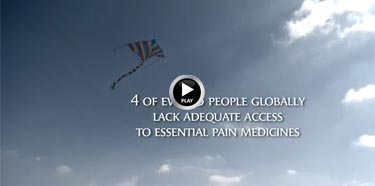
“4 of every 5 people globally lack access to essential pain medicines.”

“Over 5 billion people are affected worldwide.”

“3.6 million people will die with untreated severe pain from cancer and HIV this year.”

“99.9% of those deaths will be in low and middle-income countries.”

“15% of the world currently uses 94% of the world’s medicinal opioids.”

Ellis Paul (USA) is one of the leading voices in American songwriting and one of the top songwriters to emerge out of the fertile Boston folk scene.

Dr Frank Ferris (USA) reflects, “As I look around the world I see that about a billion people in the world have access to decent pain management and palliative care. That leaves almost 6 billion people with virtually no access to good analgesics or health care professionals who know how to appropriately administer them. To me this is a crisis.”

Call to Action

  • Tell your colleagues and friends to watch this video
  • Facilitate a discussion with them about the need for better pain control and palliative care in your community?
  • Share your experiences in the comments section below…

Supporting Resources

Posted in Treat the Pain | Comments Off on 6. We All Belong

5. What is Pain?

About this Video

Global leaders, including Dr Liz Gwyther (South Africa), Professor Michael Cousins (Australia), Dr Jay Thomas (USA), Mary Calloway (USA), Dr Kathleen Foley (USA), Dr Jim Cleary (Australia), Liliana De Lima (Colombia), Bob (Australia), Bernard (Singapore) and Teena (USA) provide notable quotes:

“Pain is an unpleasant sensory and emotional experience associated with actual or potential tissue damage or described in terms of such damage,” explains Professor Michael Cousins (Australia). He goes further to discuss the shortcomings in the treatment of pain.

Mary Callaway (USA) underscores the importance of young doctors believing patients’ pain experiences, “The patient says he’s in pain, the patient’s in pain, and then you need to figure out how to measure it, and we know how to measure it, and track it over time.”

Dr Jim Cleary (Australia) and Liliana De Lima (Colombia) reiterate the deeply subjective nature of pain.

Cancer patients Bob (Australia) and Bernard (Singapore) describe the debilitating impact that pain has had on their quality of life.

Sickle cell patient Teena (USA) goes further by explaining how she scores her pain and when she knows her threshold has been reached.

Call to Action

  • Tell a physician, nurse and a pharmacist you know to watch this video
  • Facilitate a discussion with them about the various terms commonly used in pain assessment and management
  • Share your experiences in the comments section below…

Supporting Resources

Posted in Treat the Pain | Comments Off on 5. What is Pain?

4. Opiophobia

About this Video

Opiate medications, such as morphine, are derived from opium. The World Health Organization endorses them as the gold standard to treat moderate to severe pain. Global leaders Dr Henry Ddungu (Uganda), Dr David Morrison (Canada), Dr Charles von Gunten (USA), Dr Betty Ferrell (USA), Dr Kathleen Foley (USA) and patient Carmen (Australia) provide notable quotes:

Dr Henry Ddungu (Uganda) and Dr David Morrison (Canada) explain why these fears are unfounded and reiterate that opiates are used safely by health professionals all over the world.

Criminal intent to divert important legal medicines by black market drug traffickers is identified as one of the contributing factors to opiophobia. This fear is reiterated by the testimony of late stage breast cancer patient Carmen (Australia), who at first resisted the opiate medicines that ultimately treated her pain effectively and gave her back her quality of life.

Dr Kathleen Foley (USA) reflects on the real statements of other patients saying they’d rather die of cancer than become an addict. Sadly many patients and doctors still fail to recognize that this is not an either/or situation and that pain can be effectively treated without the fear of addiction.

Dr Charles von Gunten (USA) and Dr Betty Ferrell (USA) explain that pharmacists also fear opiates for other reasons. Their anxiety is generated by robberies targeting essential painkillers for illegal sale.

The resounding message is that patients and doctors fears are uncalled for and that the positive aspects of drugs like morphine deserve far more attention. Dr Charles von Gunten underscores this point with a powerful anecdote and the clear message that, “The drug does not have the power to change people in that way.”

Call to Action

  • Tell a physician, nurse and a pharmacist you know to watch this video
  • Facilitate a discussion with them about the fears associated with the use of opioids in your community
  • Share your experiences in the comments section below…

Supporting Resources

Posted in Treat the Pain | Comments Off on 4. Opiophobia

3. Pain Pain Go Away

About this Video

Paula’s intense neuropathic pain (10 out of 10) landed her in an intensive care unit, curled up in a ball, crying. Paula only recovered her quality of life when she was treated with a combination of opiate medications through the care and persistence of her doctor, Dr Jay Thomas of City of Hope Cancer Center in Los Angeles, California. Dr Kathleen Foley (USA), Dr Jay Thomas (USA) and Paula (USA) provide notable quotes:

Paula regrets the global crisis in untreated pain that sees 4 of every 5 people lacking access to adequate pain management around the world.

Through the insight of pain expert Dr Kathleen Foley of Memorial Sloan-Kettering Cancer Center in New York we discover that pain can actually kill you.

Opiate medications, which are medicines derived from opium, are considered by the World Health Organization to be the gold standard in the treatment of moderate to severe pain.

Today, Paula’s pain is well controlled and she is relieved to have her life back again. She reports, “I love my opiates! I couldn’t live without my opiates.”

Call to Action

  • Tell several colleagues and friends to watch this video
  • Ask them if they have ever experienced pain; ask them to describe their experience
  • Share your experiences in the comments section below…

Supporting Resources

  • To follow

Posted in Treat the Pain | Comments Off on 3. Pain Pain Go Away

2. Quality of Life

About this Video

Pain and palliative care activists articulate why untreated pain is a top-priority global health issue.

They emphasize how important effective pain control is in the treatment of all patients living with pain from cancer and other diseases.

We see how pain control can help patients become functional individuals to live the lives they need to live.

Dr Kathleen Foley (USA), Dr Bernard Lapointe (Canada), patient Lorraine (USA) and Lorraine’s daughter Deanna (USA) provide notable quotes:

Call to Action

  • Tell several colleagues and friends to watch this video
  • Ask them what quality of life means to them; ask them what it feels like when they don’t have meaningful or valuable experiences in their lives
  • Share your experiences in the comments section below…

Supporting Resources

Posted in Treat the Pain | Comments Off on 2. Quality of Life